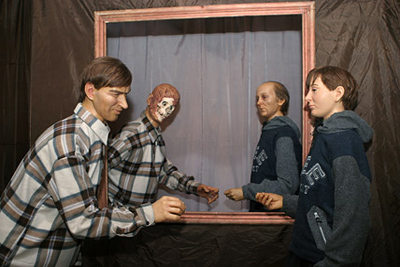
I have a natural ability to mimic most people, dialects, accents, styles and body language I have it all off to a tee. Not only that but I can flow from one straight into the other without even taking breath. It can get quite embarrassing as I don’t really have a strong accent naturally so its really obvious and I constantly have to apologise as people get quite offended as they think you're making fun of them. There is many a time when I’ve not only imitated them perfectly but I end up speaking FOR them, more whoopsies! I really can’t help it and I don’t even realise I’m doing it. If I’m talking to someone, I just start speaking to them in their own voice. It’s very spooky!
Mimickry extends to not just physical imitations, it’s catch phrases, too. Jellybeans love them and they slip off our tongues in a millisecond. You name it, every one of the current television comedy characters is represented in my house.
Its not just me - all my children have ‘echolalia’ ( the official term ) in varying degrees. My daughter is into catch phrases and a few selected accents and my eldest son would put you into hysterics in a second with his delightful innocent take offs. He is 18 and incredibly talented. My younger two sons both enjoy and are good at dialects and catch phrases.
So where does it go so wrong and how do we stop it?
It's obvious that there's a need for mimicry for it's the way the pre-schoolers learn. They watch their parents and imitate everything, it’s what they need to do in order to learn.
For many jellybeans, mimicry is the only way they know how to operate. Because they don’t have much of a clue how to behave socially, they find it helps just to imitate what they see as ‘good’ behaviour. Unfortunately for us, making people laugh is seen as good behaviour, and we don’t know that it has its limits.
Debi
What Debi describes here is, as she says, a stage in child development and language development. It's copying, or echoing, and is called echolalia. It's a conscious and effortful process for most people, but to jellybeans it comes naturally, and with many of them it lasts all their lives. An Asperger friend of mine quite often spoke in 'French', and could rattle off any amount of it. The accent and the intonation were perfect, and for those who don't understand French it must have sounded perfect. It was actually meaningless words, sometimes English words, run together and given a French accent.
Some parents of children on the autistic spectrum say that their children started to 'talk' or 'read out loud' very early indeed, except they didn't understand what they were saying. Some could memorise instantly huge chunks of written text, and after a parent had read to them, they could then repeat it word for word, and appear to be reading. Others constantly repeated what they heard on television, or would amuse themselves by repeating a catch phrase over and over again. Many retain this phenomenal memory
Many autistic children begin to talk by using echolalia as the first stage. Most of them progress to speaking single words, then phrases. Some of them seem to get stuck at the echolalia stage, and may not progress to full speech.
The ability to copy others is very pronounced in jellybean children. Tony Attwood says that they don't have natural social skills but can appear to have by adopting what he calls 'social echolalia', watching others and mimicking their social behaviour.
In marshmallow children there's an inbuilt ability to feel what others feel and do what others do. It's intuitive and takes no conscious effort at all, and instead of copying, marshmallows mirror other people's behaviour and emotions and speech, while remaining flexible to adapt for themselves the knowledge they gain by this intuitive connection with other people's minds.
The scientific reason for this is that marshmallow children have mirror neurons in their brain which are strongly wired to the decision-making centres of their brain. It's this wiring which enables them to tune in exactly to other minds and understand that other people have minds that are different from theirs but useful to them. In jellybean children the wiring isn't as strong and can short-circuit, and prove unreliable. So, instead of mirroring other minds, jellybeans consciously copy and mimic other people's behaviours and language. It's a very rapid process, and very skillful, but it's conscious.
You'll find many mentions of mirror neurons in our pages, because it's the wiring between these and other parts of the brain which is the fundamental difference between jellybeans and marshmallows. Please check them out in some of the scientific papers on the Links pages.
Barbara


No comments:
Post a Comment